The funding of FNRS: a public engagement for research
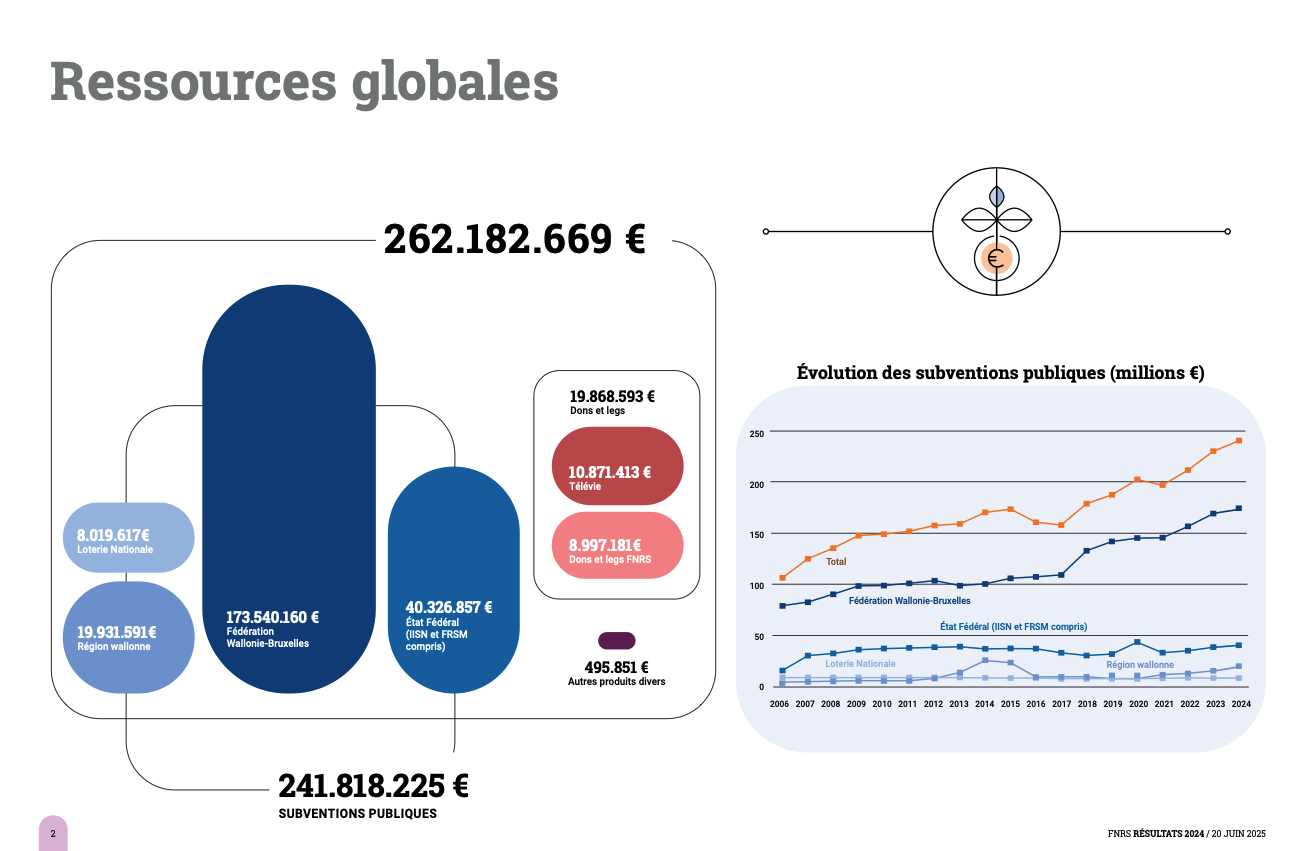
The Fund for Scientific Research – FNRS is financed mainly by public funds. In 2024, the public subsidies have reached 241.8 million euros , or more than 90% of the institution's overall resources (262.2 million euros in total).
These resources mainly come from:
- Wallonia-Brussels Federation (€173.5 million),
- Federal state (€40.3 million, including IISN and FRSM),
- Walloon region (€19.9 million),
- National Lottery (€8.0 million).
to this funding are added additional resources, such as donations and legacies (nearly €20 million, including €10.9 million from Télévie) and some miscellaneous products.
What is this funding used for?
These public subsidies directly support the career of researchers , to finance research projects and ensure the proper functioning of the FNRS. In 2024, overall spending amounted to 270.2 million euros and are distributed in particular as follows:
- €152.9 million for the remuneration of doctoral students, post-docs and permanent representatives as well as their operating credits,
- €93.3 million for the projects, credits and other instruments (fundamental research, Télévie, FRIA, FRESH, FRFS/WELBIO, etc.),
- €10.9 million for the international research and mobility ,
- €15.3 million for the administrative and logistical support ,
- as well as targeted amounts for scientific evaluation , THE support for specific initiatives (WELRI, ERC, FRArt, etc.) and international cooperation .
A concrete impact
Thanks to this public funding, the FNRS was able in 2024 to:
- support more than 2,700 scholarship holders and representatives ,
- finance fundamental research projects in all scientific disciplines,
- encourage the international cooperation and the mobility of researchers ,
- contribute to development of strategic and applied research in the Wallonia-Brussels Federation.
👉 Public financing thus constitutes the foundation of independence and scientific excellence of the FNRS. Supplemented by the generosity of donors and sponsorship actions (such as Télévie), it guarantees lasting support for fundamental research, a driver of innovation and progress for society.

Our sponsors