Votre navigateur ne supporte pas le javascript FNRS News
DONATE | |

FNRS News

Scientific Awards AstraZeneca Foundation 2024 : call for applications

On the initiative of the AstraZeneca Foundation, the Fund for Scientific Research-FNRS and the Research Foundation - Flanders (FWO) will grant, in 2024, 3 Scientific Awards to researchers from postdoctoral level onwards who are affiliated to a Belgian university or a Belgian university hospital.

Scientific Awards AstraZeneca Foundation 2024

  • Reward established investigators on the basis of their previous work, with a perspective of future development in the same field.  
  • Amount: 25.000 €/Award. Half of the amount will be attributed to the laureates for personnal use, the other half will be attributed to the laureates' laboratory.

Eligible topics

One Award will be granted in each of the following topics:

  • New advances in diagnosis/ treatment of monogenic rare diseases 
  • New multidisciplinary approaches to tackle the obesity pandemic 
  • Personalized medicine in cardiovascular diseases

Eligible candidates

  • Candidates should be active in the above mentioned fields of research, with both ongoing work related to the focus of the Award and future prospects. 
  • Candidates must be individual scientist from postdoctoral level onwardswho are affiliated to a Belgian university or a Belgian university hospital at the deadline of the call. 
  • Candidates must have held a research position in Belgium for at least five years (in a consecutive or cumulated period).  
  • Candidates must have obtained their first PhD degree maximum 15 years before the date of the submission deadline (possibly extended in case of eligible career breaks). 
  • Candidates may not have received an Award for the work submitted with the same amount (or higher) in the last 3 years (at the deadline of the call).
  • Candidates can only apply to one AstraZeneca Award per call. 
  • Personnel of the AstraZeneca Foundation or affiliated to the AstraZeneca Foundation are not eligible for the Awards.

Call timeline

  • Opening of the call: April 25th, 2024
  • Deadline of the call: June 10th, 2024
  • Jury meeting: Fall 2024

How to apply?

Applications, written in English, must be sent electronically to This email address is being protected from spambots. You need JavaScript enabled to view it. on June 10th, 2024 at the latest.
 
The requested documents are :

  • The application form pertaining to the Award you wish to apply to (see below), duly completed and signed.
  • A detailled curriculum vitae.
  • A complete list of publications.

Regulations:

 Application forms:

 The list of the previous laureates is available here.

Questions about the Award should be adressed via email to This email address is being protected from spambots. You need JavaScript enabled to view it..

AstraZeneca-2024


Conclusions of the conference "Unlocking the power of science communication"

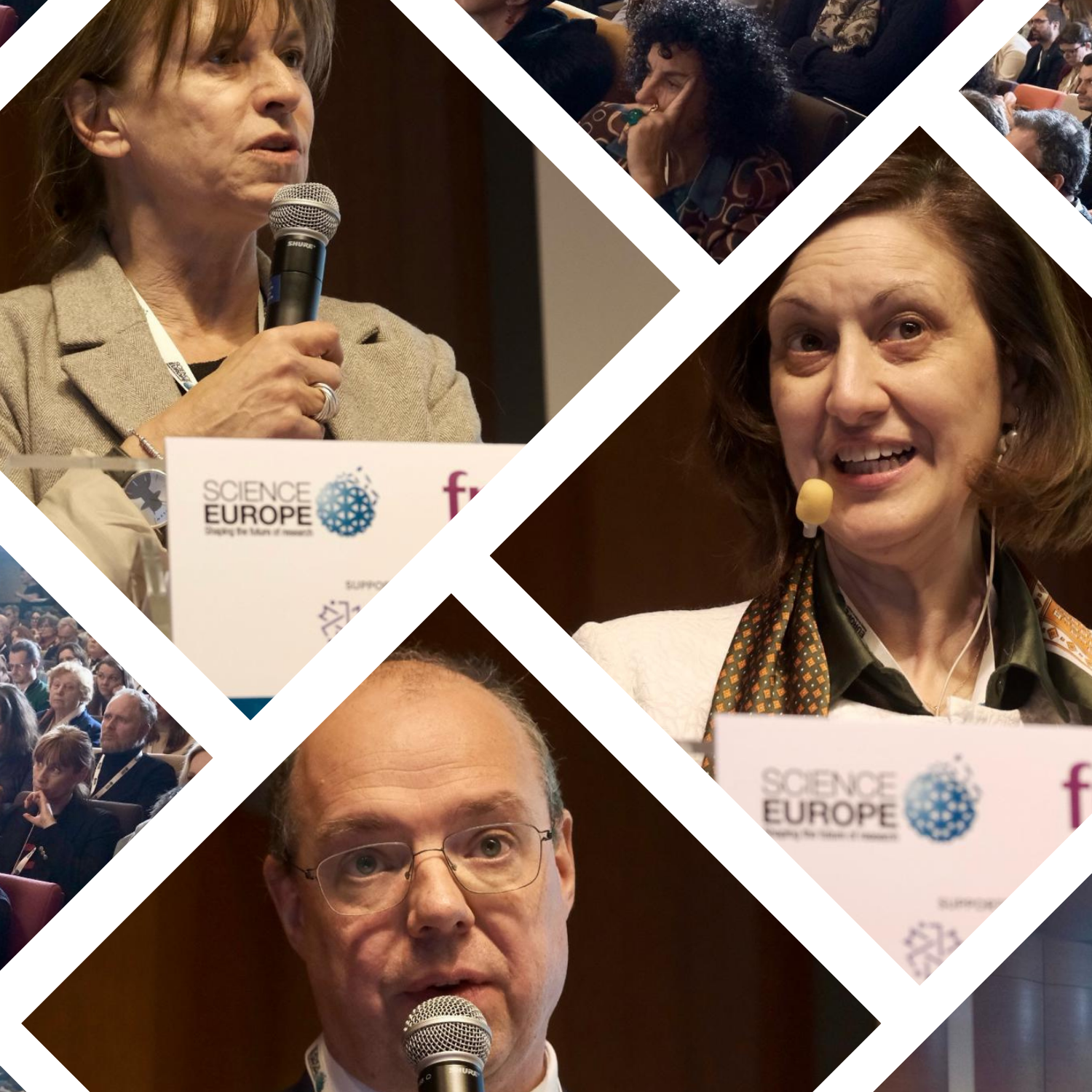
On Tuesday 12th and Wednesday 13th March 2024, Science Europe, the FNRS and the FWO organised a high-level conference at the Palais des Académies in Brussels, entitled "Unlocking the power of science communication in research and policy-making". Held under the auspices of the Belgian Presidency of the Council of the EU, the aim of the event was to highlight the importance of science communication in research processes and to raise awareness of the need to address it more formally in both research programmes and policy-making.

The event brought together more than 750 people - on site and online - scientists, communicators and representatives of European and international scientific institutions.

On the programme for the two days: two sessions bringing together speakers on crucial issues such as the role of science communication, its current priorities and the incentives and obstacles to science communication in Europe. More in-depth angles were tackled in 'Deep dives', on how to communicate science to policy-makers, respect for integrity and ethics and the different ways of integrating diversity, inclusion and equity into science communication, or what science communication can contribute to the fight against misinformation. In a final session, several representatives of institutions were invited to present - in just a few minutes - an example of good practice and successful initiatives in science communication. These sessions brought together more than 60 speakers from European and international scientific institutions.

To close these rich exchanges, the 3 General Secretaries presented their conclusions and a summary of what had been discussed over the 2 days. Here are a few extracts:

"Policy-makers need the contribution of the scientific community to develop a particular vision of society or to meet societal challenges", Véronique Halloin, Secretary General of the FNRS

"Scientists and the media must remind the public that science is a slow and iterative process aimed at converging towards a consensus by confronting different ideas", Hans Willems, Secretary General of the FWO

"One of the aims of this conference is to include these recommendations in the agenda of the Belgian Presidency of the Council of the European Union", Lidia Borrell-Damian, Secretary General of Science Europe


Strategic conclusions drawn from the Conference “Unlocking Power of Science Communication”

This position statement outlines specific recommendations addressed to European institutions, national governments, and research organisations. It emphasises the key messages of :

  1. The importance of integrating science communication within research and innovation systems, advocating for its prioritisation at national, European, and global levels.
  2. The necessity of enhancing researchers' communication skills, combatting misinformation, and promoting public engagement through innovative approaches.
  3. The vital role of science communication in demonstrating the value of research investments and fostering public trust in the scientific process.

Full strategic conclusions

Pictures


CclScEu


One million euros for research into rare thyroid pathologies

The Generet 2023 Prize for Rare Diseases is awarded to Sabine Costagliola, FNRS Research Director and Director of the IRIBHM (ULB), for her research using human organoid technology to model two rare thyroid diseases.

Awarded for the 6th consecutive year, this Generet Fund Prize, managed by the King Baudouin Foundation as part of its collaboration with the FNRS and the FWO, is worth one million euros, making it the most prestigious distinction for rare diseases in Belgium. The jury of independent experts hails Sabine Costagliola's ambition to use her research to improve the diagnosis and quality of life of patients suffering from these diseases.

Professor Sabine Costagliola has been studying the mechanisms underlying thyroid development and thyroid pathologies for many years at the Institut de Recherche Interdisciplinaire en Biologie Humaine et Moléculaire (IRIBHM) at the Université Libre de Bruxelles. Prof. Costagliola explains:

“Despite identification of many of the genes involved in normal development of the thyroid, the molecular mechanisms underlying thyroid problems are still poorly understood. Today, we can explain around 10% of the cases of congenital hypothyroid, but this means that the great majority remain unexplained. The aim of my research is to understand why a child is born without a thyroid or has a poorly functioning thyroid.”

Professor Costagliola’s ambition goes beyond just basic research:

“The Generet Prize gives me the liberty to explore all hypotheses, thus opening the way to discovering new diagnostic tools and, in the longer term, to find new therapeutic solutions.”

Whilst living without a thyroid or with a dysfunctional thyroid is possible, this nevertheless means taking synthetic hormones for life. As Professor Costagliola explains,

“Treatment with synthetic hormones can never totally replace a normal thyroid. Moreover, hormone needs change throughout our life and this requires constant fine adjustments. For some patients we never manage to find the optimal doses and this affects their everyday quality of life. We cannot be satisfied with patients being more or less alright, we must go further. If one day, we manage to succeed in transplanting a functional thyroid in patients, this will enable them to lead an incredibly more comfortable life.”

More information on the 2023 winner of the Generet Prize


Unlocking the power of Science Communication in Research and Policy Making

Science Europe, the FNRS and Fonds Wetenschappelijk Onderzoek - Vlaanderen (FWO) are co-organising a High-level Conference on Science Communication on 12 and 13 March 2024 in Brussels.

Held under the auspices of the Belgian Presidency of the Council of the EU, this event intends to highlight the importance of science communication in research processes and raise awareness of the need to address it more formally in both research programmes and policy making.

More info...


Opening of the 7th Generet Award for Rare Diseases call for applications

On the initiative of the Fund Generet, managed by the King Baudouin Foundation, the prestigious Generet Award will be granted in 2024, for the 7th time, to support a 4-year research project in the field of rare diseases in Belgium.

Generet Award for Rare Diseases

Amount: 1.000.000 € over 4 years. A first instalment of 500.000 € will be credited for 2 years. The second instalment of 500.000 € will be subject to the positive evaluation of a mid-term report.

Rare diseases are considered to be life threatening or chronic conditions which affect no more than 1 person out of 2.000. Rare cancers and rare adverse drug events research projects are not eligible for this call.

Application procedure

Proposals will undergo a two-step application procedure encompassing a phase of pre-proposal (open to all) and a phase of full proposal (accessible to shortlisted applicants from the first stage).

Applicants participating in the pre-proposal phase must fill in a short pre-proposal form and provide a letter of intent of max. 3 pages focusing on the scientific proof of concept of the research project and attach a relevant core bibliography and short CV information

Eligible candidates

Candidates must be: 

  • Internationally established investigators, with outstanding scientific achievements and multiple seminal contributions in the field of rare diseases.
  • Internationnaly established investigators, with outstanding scientific achievements and multiple seminal contributions in common diseases, who can demonstrate that their research will have a substantial added value for rare diseases and can accelerate research in this particular field.

Candidates must have a scientific seniority of min. PhD + 10 years (career breaks, such as maternity leave or long-time illness, not included).

Candidates must be affiliated to a Belgian University, a Belgian University Hospital or an eligible Research Institute, until December 31st, 2028 and not reach the retirement age limit during the project timeframe.

Former laureates cannot reapply to the Generet Award as Principal Investigator but can be partners in other applications (at the earliest 4 years after being laureate).

Eligible research projects

The research project must be conducted in Belgium in the field of rare diseases.

The research project should aim at a better understanding of the processes underpinning rare diseases and translating fundamental discoveries into better prevention, diagnosis or treatment for patients. Research can encompass all stages from bench to bedside.

Eligible expenses

Eligible expenses encompass personnel costs, running costs and equipment. A max. of 10% overheads may be applicable (subject to negotiation).

Up to 30% of the Award's amount can be outsourced for supporting international or intranational expenses (personnel and running costs) including the private sector if they charge at cost price.

Call timeline

  • Opening of the call: February15th, 2024
  • Pre-proposals deadline: April 15th, 2024
  • First Panel meeting: End of May 2024
  • Invitation for full proposals: Following the first Panel meeting
  • Full proposals deadline: July 8th, 2024
  • Second Panel meeting: Mid-November 2024
  • Start of the research: January 1st, 2025

How to apply?

Pre-proposals, written in English, must be submitted via the online application system available on www.generetaward.be on April 15th, 2024 at the latest.

The complete regulations of the Generet Award 2024 are available here

The list of the previous laureates is available here.

Questions about the Award should be addressed via email to This email address is being protected from spambots. You need JavaScript enabled to view it..
Submit a pre-proposal

Generet2024


Contact us

Fund for Scientific Research - FNRS

Rue d’Egmont 5

B - 1000 Bruxelles

Tél : +32 2 504 92 11

BE55 0016 0000 0044

Contact the FNRS